
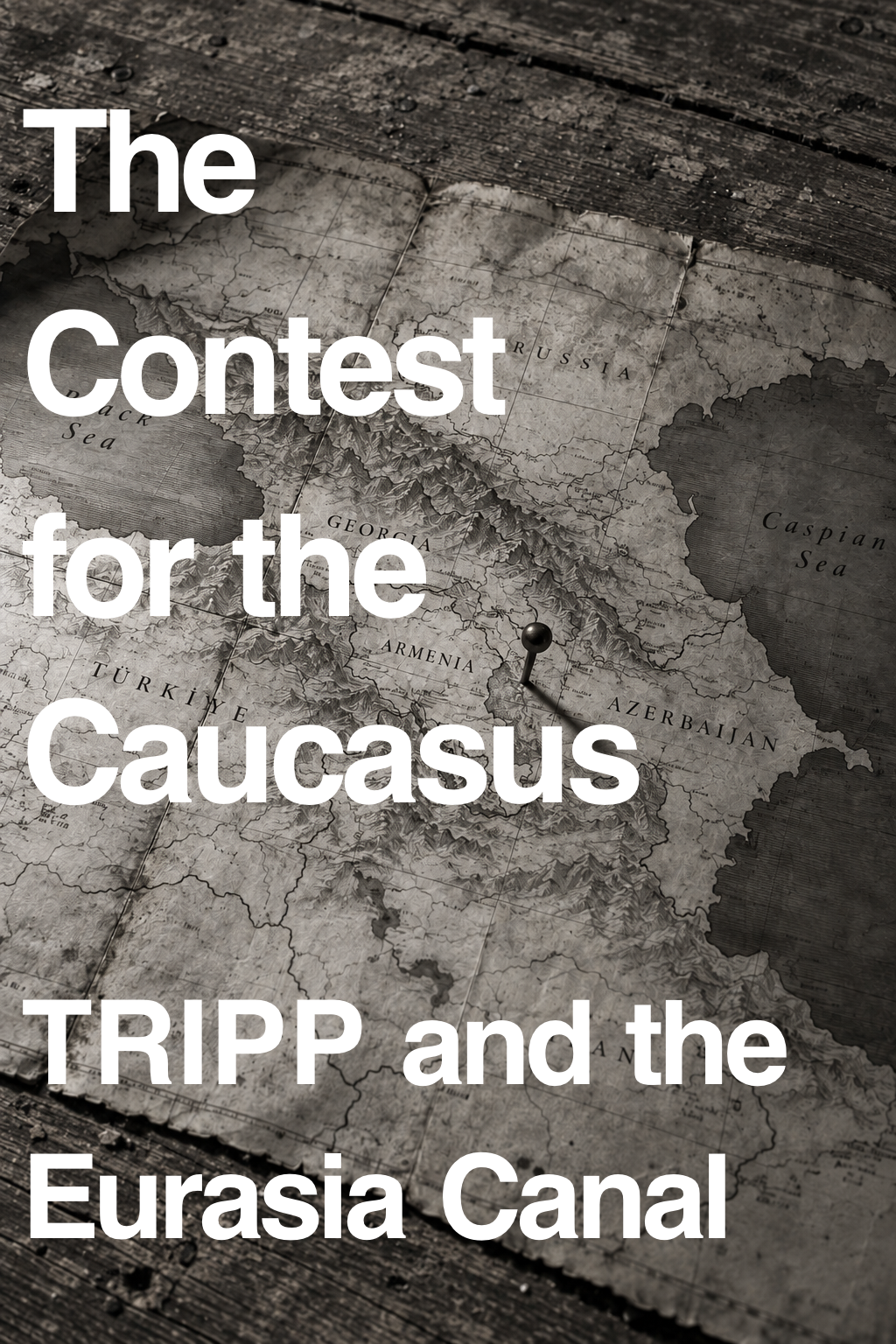
Far Eastern Economic Forum, Vladivostok—At this year’s forum, rumors circulated that competition over Eurasian transport corridors is intensifying with two strategic visions now colliding in the South Caucasus. The first is the U.S.-backed Trump Route for International Peace and Prosperity (TRIPP), a multimodal corridor designed not merely to move freight but to open a new front in the destabilization of both Russia and Iran by severing their traditional influence in the Caucasus. To counter this, Russia is reviving an old Soviet-era proposal: the Eurasia Canal. A 700km waterway project intended to connect the Caspian Sea to the Black Sea entirely through Russian territory through the Kuma-Manych Depression, bypassing TRIPP and sidelining its regional linchpin—Azerbaijan—entirely.
Moscow’s renewed interest in the waterway projects is a direct geopolitical response to TRIPP’s rapid institutionalization and the wider Western effort to pry the South Caucasus away from Russian and Iranian influence. What is emerging is a contest for the Caucasus itself—a struggle over which power bloc will shape the region’s economic and strategic orientation.
The TRIPP Initiative: A Western Corridor
Origins and Structure
TRIPP grew out of the U.S.-brokered Armenia-Azerbaijan peace framework initialed on August 8, 2025, when Armenian Prime Minister Nikol Pashinyan and Azerbaijani President Ilham Aliyev signed a Joint Declaration at the White House. At the center of the corridor project is a 43-kilometer transport link through Armenia’s Syunik province, connecting mainland Azerbaijan to its Nakhchivan exclave and, by extension, to Turkey.
The project marks an unprecedented American incursion into former Soviet space. In June 2026, the U.S. approved the establishment of the TRIPP Development Corporation U.S. (TDC US), which will serve as majority owner of a joint entity formed in Armenia. The first phase of the deal grants the U.S. side a 74% stake with Armenia retaining 26% for an initial 49-year period.
Implementation Progress
Construction of the Armenian section is expected to begin soon in 2026 while Azerbaijan has committed to completing its railway and highway connections to the Armenian border by early 2027. In August, the U.S. State Department announced that engineering surveys for the railway in Armenia were already underway, with the Trans-Caspian Enterprise Fund driving private sector investment.
The project has already attracted European backing. In August 2026, the EU launched a transport connectivity platform aimed at linking Europe with Central Asia through the Black Sea and South Caucasus, with plans to mobilize approximately €2 billion for infrastructure development.
Strategic Objectives: A New Front Against Russia and Iran
TRIPP serves multiple interconnected U.S. objectives, but its geopolitical purpose transcends commercial logistics. The corridor is clearly designed to create a genuine alternative to Russian and Iranian transport routes, with the United States undoubtedly seeing it as a way to limit the regional influence of Russia, Iran, and China. By establishing U.S.-controlled infrastructure in Armenia—a country where Russia maintains a military base and where Russian Railways operate the national rail network under a concession valid until 2038—Washington is now competing directly with Moscow in its historical sphere of influence.
For Iran, the implications are even more immediate. The corridor would place American-controlled infrastructure directly along Iran’s northern border, a prospect Tehran has described as “geopolitical strangulation.” The current U.S.-led war against Iran has only sharpened these concerns. Iranian Ambassador to Armenia Khalil Shirgholami stated flatly that “Iran cannot help but be concerned about the US presence near its borders.”

With Armenia’s railways managed by a subsidiary of Russian Railways, Russian Deputy Foreign Minister Mikhail Galuzin highlighted the obvious security concerns raised by the need for TRIPP to interface with existing Russian-controlled infrastructure. Under a 1992 agreement, Russian border troops have guarded Armenia’s borders with Turkey and Iran, meaning “one way or another, Russia’s position will have to be taken into account.”

Azerbaijan: The Linchpin of TRIPP
The Architecture of Western Financial Dominance
At the heart of the U.S. strategy lies Azerbaijan—a country whose strategic orientation has been fundamentally shaped by three decades of Western financial entanglement, primarily through British Petroleum. The numbers are staggering. BP’s investment—with coventurers—has exceeded $89 billion in Azerbaijan since beginning operations there 34 years ago.
BP remains a central investor and operator in Azerbaijan’s energy export sector: it operates the ACG oil fields and Shah Deniz gas field and retains substantial stakes in the associated export pipelines. This grants London unparalleled leverage over Azerbaijan’s economic—and by extension, political—life. BP’s investment is the bedrock of an economy heavily dependent on hydrocarbon revenues and creates a structural dependency that inexorably bends Baku toward the Western orbit.
Azerbaijan’s Pivot Toward the EU and the United States
Azerbaijan’s Western orientation is accelerating. In February 2026, U.S. Vice President JD Vance visited Baku, where he and President Aliyev signed a Charter on Strategic Partnership covering defense, security, trade, and investment with Vance explicitly linking TRIPP to American strategic interests. Additionally, the energy relationship with Europe has deepened dramatically. President Aliyev noted in July 2026 that half of Azerbaijan’s gas exports now go to EU member states. European Commission President Ursula von der Leyen launched a €200 million program to link Southern Caucasus countries through transport, energy and digital connectivity—initiatives that dovetail perfectly into the TRIPP architecture.
Baku’s deepening embrace of the West has led both Moscow and Tehran to view Azerbaijan with increasing suspicion. While Baku officially maintains a “multi-vector” foreign policy, the structural realities of its economic dependency and its strategic alignment on energy and transit increasingly point in one direction: West.
Russia’s Counter: The Eurasia Canal and the Volga-Don Alternative
Russia’s counter to TRIPP is the revival of an old Soviet proposal. The Soviet government began constructing a Manych waterway in the 1930s, but the full Black Sea-Caspian connection was never completed. Under the current proposal this waterway would form the backbone of the infrastructure project. Kazakhstan’s President Nursultan Nazarbayev revived the modern proposal in 2007, and the idea has periodically resurfaced in Russian, Kazakh, and Eurasian Economic Union discussions.
The proposed canal would run approximately 700 kilometres through Russian territory, exploiting the Kuma-Manych Depression to connect the Caspian Sea to the Sea of Azov and on to the Black Sea, accommodating vessels up to 10,000 tonnes and carrying 45-75 million tonnes annually. A more ambitious version of the proposal envisages a waterway capable of accommodating vessels up to 26,000 tonnes
Revival of the project is a direct response to TRIPP’s progress. Unlike TRIPP, which depends on Azerbaijan as its linchpin, the Eurasian Canal would bypass Azerbaijan entirely. Cargo would move from the Caspian through Russian territory to the Sea of Azov and on to the Black Sea—without touching Azerbaijani infrastructure, Armenian territory, or Western-controlled nodes. The project is designed to offer Caspian states—particularly Kazakhstan and Turkmenistan—an alternative to the Western-backed TRIPP corridor.
The Geopolitical Competition: A Contest for the Caucasus
Russia and Iran: TRIPP as Destabilization
From Moscow’s perspective, TRIPP represents a direct challenge to its traditional role in the Caucasus. Deputy Secretary of Russia’s Security Council Alexei Shevtsov warned at the Vladivostok forum that TRIPP would allow the United States to place “its troops or private military companies, intelligence infrastructure directly on the territory of Armenia and near the border with Iran.”
Here, the Russian and Iranian positions converge on a shared perception: TRIPP is not a neutral commercial initiative but a vehicle for American strategic encirclement. Iran regards the project as a threat because it would diminish Iran’s transit role and introduce a long-term American presence immediately north of the Iranian border. Even before the US-led assault on Iran, Iranian officials openly described the project as “geopolitical strangulation” and declared that Iran will block the corridor initiative “with Russia or without it.”
The Eurasia Canal as Strategic Counter
The Eurasia Canal represents Russia’s attempt to offer an alternative vision of Eurasian connectivity—one that reinforces rather than bypasses Russian territory. For Russia, the canal would:
- Reinforce Russia as the transit gatekeeper for Caspian access to the Black Sea, ensuring that any north-south or east-west trade flows through Russian territory
- Bypass Azerbaijan entirely, denying the West its linchpin state and undermining the commercial rationale for TRIPP
- Offer Caspian states an alternative to the Western-backed corridor, one that does not require routing trade through American-controlled infrastructure
- Support Russia’s strategic reorientation away from Western markets toward “friendly” states, with a goal of 80% of trade flowing through non-Western partners
The Eurasia Canal project also aligns neatly with the economic interests of China, as well as Caspian and Central Asian states.
TRIPP’s Remaining Challenges
Despite its apparent momentum, TRIPP faces significant challenges. When the U.S. and Armenia announced its implementation framework in January 2026, the Armenia–Azerbaijan peace treaty had been initialled but as of today has not yet been signed. Azerbaijan continues to demand Armenian constitutional changes concerning territorial claims and customs and inspection arrangements remain politically sensitive.
Considerable rail reconstruction will also be necessary, as Soviet-era lines have been abandoned or damaged for decades with additional private financing is still needed. Above all, TRIPP’s success depends on the durability of the Armenia-Azerbaijan peace settlement and the continued alignment of Azerbaijan with Western strategic objectives. Without these, the corridor remains vulnerable to political disruption.
The Broader Geopolitical Context
The competition between TRIPP and the Eurasia Canal reflects a larger struggle over the architecture of Eurasian connectivity. The U.S.-backed corridor represents an effort to create an east-west system that simultaneously avoids and undercuts both Russia and Iran, connecting Europe and the Black Sea to Central Asia through the South Caucasus. It is, in essence, a strategy to sever the Caucasus from its historical Russian and Iranian orientation and anchor it firmly in the Western orbit.
Russia’s canal proposals represent an attempt to maintain control over the Caspian’s maritime access to the Black Sea, ensuring trade flows through Russian territory. For Kazakhstan, the calculus is complex. The country has invested heavily in the Middle Corridor, developing its Caspian ports and railway connections to Azerbaijan and Georgia. But it also has historical ties to Russia and has previously participated in discussions about the Eurasia Canal. This suggests that Astana is hedging its bets, reluctant to become entirely dependent on a Western-backed route that could be disrupted by geopolitical shifts.
The Caucasus itself is the ultimate prize. For Russia, the region is a historical sphere of influence, a buffer against threats from the south, and a critical link in its connections to the Middle East and South Asia. For the United States, the Caucasus represents an opportunity to project commercial and strategic influence deep into Eurasia, to access Central Asian resources, and to constrain both Russian and Iranian power. For the countries of the region—Armenia, Azerbaijan, and Georgia—the competition offers both opportunities and risks, as they try to balance between competing great powers while pursuing their own national interests.
Conclusion
The emergence of TRIPP has revived Russian interest in the Eurasia Canal as a strategic counterproposal. What began as rumours in Vladivostok has proven prescient—Moscow is moving to counter TRIPP with its own vision for Eurasian connectivity, one designed to bypass Azerbaijan entirely and reinforce Russian control over Caspian maritime access to the Black Sea. While TRIPP has moved from diplomatic concept to institutional reality, the Eurasia Canal remains in the earlier stages of development.
The strategic competition is real: TRIPP would shift Eurasian connectivity toward Azerbaijan, Turkey, and Western-backed infrastructure, while the Eurasia Canal would keep Caspian access to the Black Sea under Russian control and bypass Azerbaijan entirely. But at a deeper level, the competition is about the future of the Caucasus itself—whether the region will be oriented toward the West or remain within Russia’s sphere of influence.
For Russia and Iran, TRIPP is rightly understood as an attempt to consolidate U.S. control at the expense of regional sovereignty. For Azerbaijan, the massive weight of Western capital—particularly BP’s structural dominance—creates a dependency that makes it the indispensable component of America’s Caucasian strategy. And for Russia, the Eurasia Canal is more than just an infrastructure project: it is a geopolitical counter move. It allows Russia to offer Caspian states a transport corridor that does not route trade through U.S.-controlled infrastructure or depend on a state that has been captured by Western capital.
How this competition plays out will shape not only the economic geography of Eurasia but also the geopolitical balance of power in a region where empires have clashed for centuries. The rumours in Vladivostok were not idle chatter—but a sign that the contest for the Caucasus is just starting. A contest that will define the region for decades to come.